 Canada
 Cayman Islands
 Dominican Republic
 Hong Kong
 India
India
 Indonesia
 Ireland
 Jamaica
 New Zealand
 Singapore
 Thailand
 United Kingdom
 United States
 Vietnam

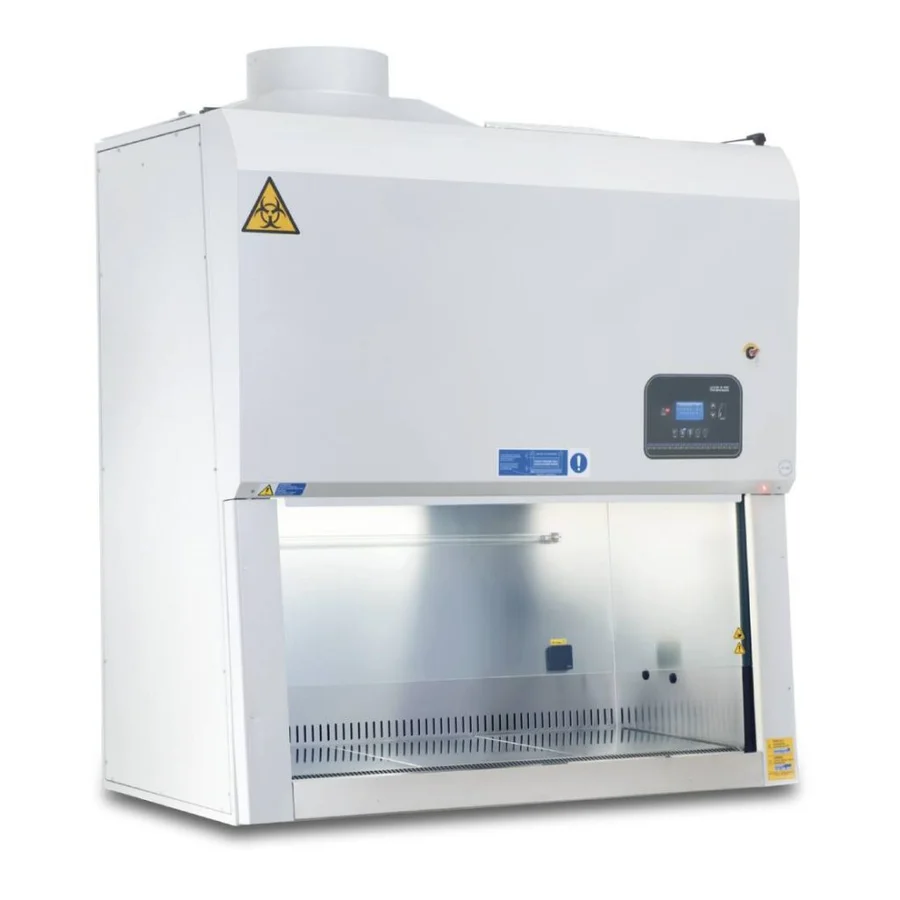
Anyone running a lab that handles volatile chemicals, radionuclides or hazardous aerosols knows a standard biosafety cabinet doesn't always meet the containment specification. Some protocols simply demand total exhaust, not a partial recirculating solution. That's where the class ii type b2 cabinet earns its reputation as the workhorse of high-risk research and toxicology settings.
What Sets Type B2 Apart
Most Class II biological safety cabinets recirculate a portion of HEPA-filtered air back into the work zone. A Type B2 doesn't. Every volume of air drawn into the cabinet passes through HEPA filtration and is exhausted directly outside the building via a dedicated hard-ducted system, with zero internal recirculation. Inflow air enters through the front access grille, establishing an inward airflow barrier that delivers operator protection, while the total exhaust configuration removes potentially contaminated air before it has any chance to linger in the work zone. For labs working with toxic vapours or trace radionuclides, this total exhaust design isn't a nice-to-have. It's the difference between a compliant containment setup and a genuine biosafety gap.
Where They Actually Get Used
Toxicology laboratories, pharmaceutical research facilities and university departments conducting work with volatile hazardous chemical agents tend to specify B2 cabinets precisely because standard recirculating configurations aren't rated for that exposure load. Pathology and nuclear medicine research labs handling radionuclides face comparable constraints under their radiation safety protocols. If your work involves compounds that shouldn't touch recirculated air under any circumstances, a B2 unit removes that variable from the risk assessment entirely.
The Infrastructure Trade-Off
Nothing comes free, and B2 cabinets do place greater demands on a facility's mechanical infrastructure than their B1 or A2 counterparts. Because 100% of the exhaust airflow is ducted externally, the facility requires a dedicated exhaust connection sized correctly for the cabinet's air handling capacity, along with adequate make-up air to maintain proper pressure balance. Getting that calculation wrong causes negative pressure imbalances, and a poorly balanced cabinet compromises its own containment integrity. Planning the ductwork specification early, before the cabinet's commissioned, saves considerable retrofitting downstream.
Keeping Performance Where It Should Be
A cabinet's containment is only as reliable as its last certification cycle. Face velocity readings drift, HEPA filter seals degrade, and ductwork connections loosen over time, none of which surfaces until the units actually tested. Annual certification verifies inflow and downflow velocities, HEPA filter integrity via DOP or PAO testing, and alarm function, and it should be repeated whenever the cabinet is relocated or undergoes servicing. Booking biosafety cabinet servicing vic technicians on a routine schedule, rather than waiting for a fault to surface, keeps containment performance within specification and avoids compliance surprises during an audit.
Worth the Investment
Type B2 cabinets aren't the cheapest line item on a procurement quote, and they're not meant to be. They're engineered for labs where the risk assessment genuinely calls for total exhaust containment. For research teams handling hazardous chemicals day in, day out, that capital outlay buys containment assurance a standard recirculating cabinet simply can't deliver.
To know more https://laftech.com.au/product/bioair-safemate-total/